


At Open Sky International, your child sits GCSEs and IGCSEs at the end of Year 11 (2de), in our examination centre, accredited by Pearson Edexcel since 2022. Studied in more than 80 countries, they are prepared in English and French in Boulogne-Billancourt.
The GCSE (General Certificate of Secondary Education) is the qualification awarded at the end of lower secondary education in the United Kingdom. The IGCSE (International GCSE) is the version designed for schools outside the United Kingdom: the same requirements and the same level, with syllabuses and exam sessions adapted for international schools. Both are awarded by accredited British exam boards; at Open Sky International, by Pearson Edexcel.
Students prepare for their GCSEs and IGCSEs over two years, in Year 10 (3e) and Year 11 (2de), and sit them subject by subject. Each subject leads to a separate qualification graded from 9 to 1, the first step towards A Levels.
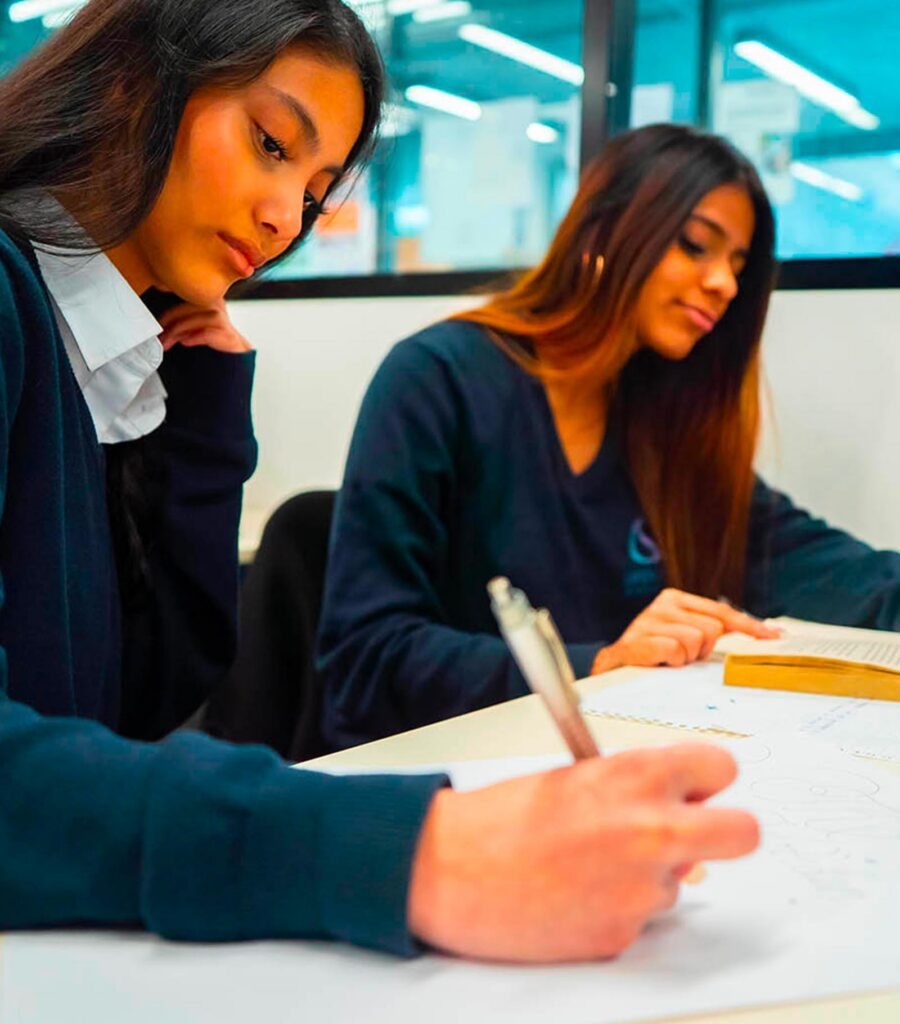
Since 2022, Open Sky International has been an accredited Pearson Edexcel examination centre, one of the few schools in France to hold this status. Our students sit their GCSE and IGCSE exams at their own school, in familiar surroundings, without travelling to an external centre. Exam entries, invigilation and the dispatch of scripts are handled by the school. The school does not accept external candidates.
GCSE and IGCSE results are published by Pearson Edexcel in August. Every year, we analyse them and compare them with schools in England, independent schools and international schools in Paris.
The cycle begins in Year 10 (3e). In addition to history and geography, taught in French, your child studies the 9 subjects they will sit at GCSE and IGCSE: French, Spanish, Business Studies, maths, physics, chemistry, biology, English language and English literature. Preparation lasts two years.
Mock exams in January prepare students for the final exams in May and June, and results are published in August.
Each subject is graded from 9 (the highest) to 1: a 4 is a “standard pass”, a 5 a “strong pass”, and a 7 or above corresponds to the old A grade. These GCSE and IGCSE grades, subject by subject, determine which A Levels are open to students in Sixth Form. Our students receive a results statement for each subject and guidance in choosing their A Levels from the end of Year 11. At the end of Year 10 (3e), students who are fluent in French can sit the French Brevet (Diplôme national du brevet, DNB), the national exam at the end of French middle school, as an independent candidate. Their French and history and geography lessons prepare them for it.
All students sit all 9 subjects: there are no options.
| Subject | Qualification | Exam language |
|---|---|---|
| Mathematics | GCSE | English |
| Physics | IGCSE | English |
| Chemistry | IGCSE | English |
| Biology | IGCSE | English |
| English Language & Literature | GCSE | English |
| French | IGCSE | French |
| Spanish | IGCSE | Spanish |
| Business Studies | IGCSE | English |
GCSEs and IGCSEs are sat at 16, at the end of Year 11 (2de), subject by subject: they have no exact equivalent in the French system. In terms of level, they fall between the Brevet (taken at 15) and the French baccalauréat, the national school-leaving qualification. They determine entry to Sixth Form and the choice of A Levels.
Passing 3 A Levels is recognised as equivalent to the baccalauréat.
| Qualification | Age | Year Group | Format |
|---|---|---|---|
| French Brevet (DNB) | 15 | Year 10 (3e) | National exam, 4 papers |
| GCSE / IGCSE | 16 | Year 11 (2de) | One qualification per subject, graded 9 to 1 |
| A Levels | 18 | Year 13 (terminale) | 3 to 5 subjects, graded A* to E |
| French baccalauréat | 18 | Year 12 (French baccalauréat) and Year 13 (terminale) | Continuous assessment + 2 specialist subjects |
A tour of the school while classes are in session, from preschool through high school.
You leave with an answer regarding the available space.
GCSE and IGCSE results determine which subjects a student can study in greater depth in Sixth Form. Students choose between three and five, including French, and spend two years preparing for A Levels, the qualification for university entry. Notre lycée bilingue : A Levels à Paris.
In 2026, in our first cohort, 33% of students achieved A*–A at A Level (England average: 28%) and 100% achieved grades between A and E (England average: 97%).
Both are at the same level and use the same type of exam. The IGCSE is the international version, with syllabuses and exam sessions adapted for schools outside the United Kingdom. Depending on the subject, our students sit one or the other: GCSE in maths and English, IGCSE in the other subjects.
Your child sits 9 subjects, with no options: maths, physics, chemistry, biology, Business Studies, English language, English literature, Spanish and French. History and geography, taught in French, are not sat at GCSE or IGCSE.
No. IGCSEs, like the DNB, are end-of-cycle qualifications but do not give access to university. It is A Levels, prepared in Sixth Form (Year 12 and Year 13, 1re and terminale), that open the way to higher education, in France and abroad.
At the school, in our accredited Pearson Edexcel examination centre, during the May–June exam session in Year 11. Results are published by Pearson Edexcel in August.
Yes, in Year 10 (3e), which begins the GCSE and IGCSE cycle. Entry into Year 11 (2de), midway through the cycle, is considered on a case-by-case basis after an assessment.
Yes. At the end of Year 10 (3e), students who are fluent in French can sit the Diplôme national du brevet as an independent candidate. Their French and history and geography lessons prepare them for it.
Let's discuss your child's educational journey, from GCSEs and IGCSEs to A Levels.
Quelques places disponibles pour 2026 !
Préparez votre rentrée 2027 !
Some available places for 2026 !
Prepare your 2027 school year !