


Our bilingual teaching approach rests on five principles and one standard: native-speaker teachers (with many years of experience, all holding a PGCE), two languages of instruction every day, curricula designed by the school based on the British, Singaporean and French curricula, and high standards that exclude no one. This is how our students become bilingual and succeed at GCSE, IGCSE and A Level.
English-French immersion teaching, from age 2 to 18.
Based on the British, Singaporean and French curricula.
Each teaches in their own language.
Phonics for learning to read, Singapore maths for learning to count.
EAL and FAL support built into the week.
Towards GCSEs, IGCSEs and A Levels.
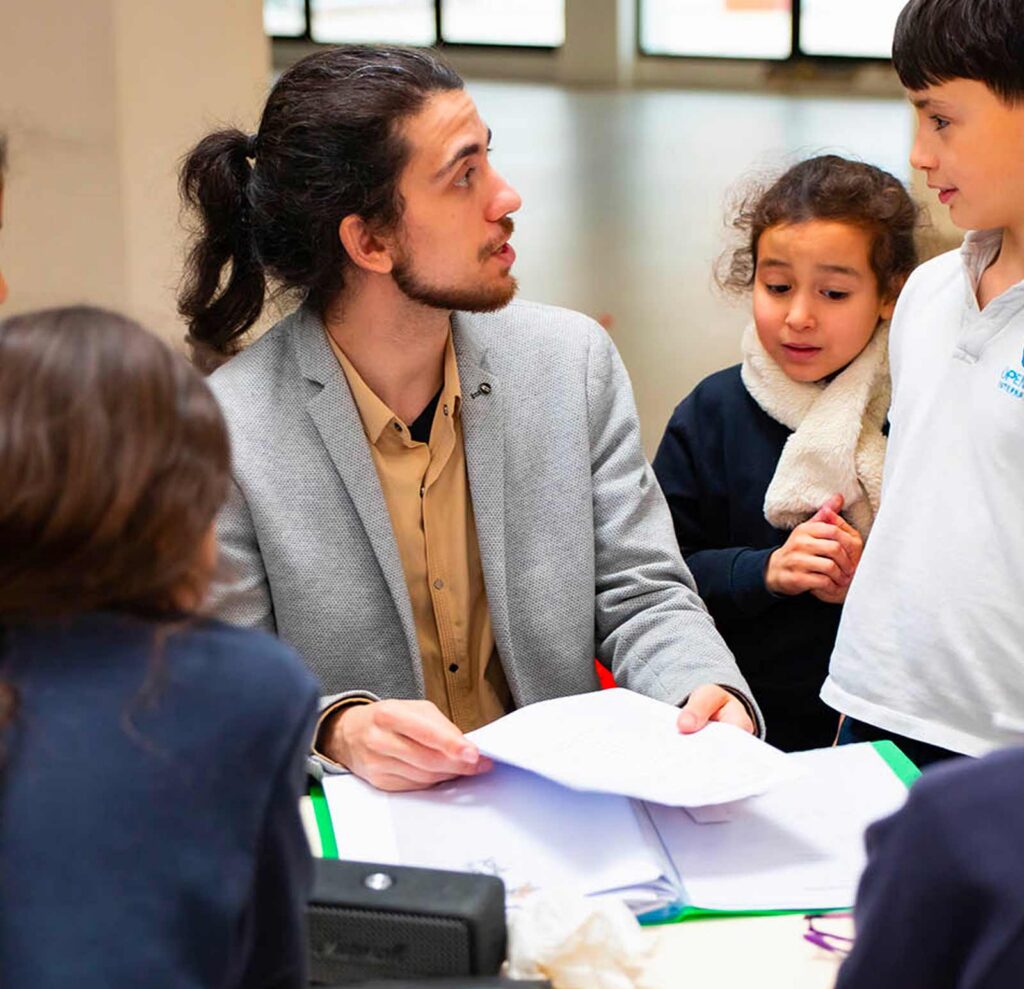
From age 2, your child spends the school day in both languages: some subjects in English, others in French, every day, with teachers who speak only their own language in class. Your child is not “taking English lessons”: they learn science in English and history in French, and both languages become tools for learning.
This approach is the same from preschool to high school; only the split of subjects between the two languages changes at each stage. How immersion is organised, level by level.
Open Sky International is an independent international school that designs its own curricula and teaching approach. This approach draws on the English National Curriculum for the structure of learning and for qualifications, Singapore maths for mathematics, and the French curriculum for language, literature, history and geography. The idea is to take the best of the different curricula worldwide and, where that is not enough, to design our own.
The result is a demanding curriculum that goes well beyond the requirements of the French core curriculum (socle commun) set by the French Ministry of Education (Éducation nationale). Our pupils and students are generally one to two years ahead.
Each teacher teaches in their native language, and only in that language: this is the third principle of our teaching approach. Open Sky International has around twenty teachers. They are all experienced, hold a PGCE and have international experience. 25% of them are teachers specialising in language learning (EAL and FAL).
Small classes (a maximum of 20 students per class) allow individualised teaching in both languages.
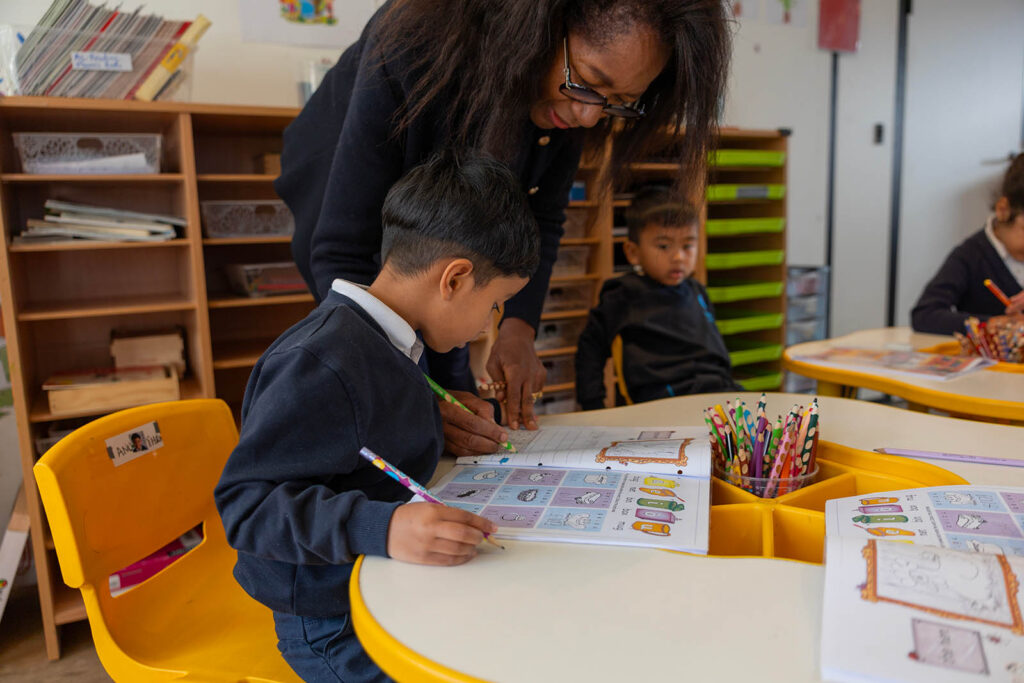
This approach moves from the concrete to the abstract (handling objects, drawing, then calculating) so that children understand before they memorise. Singapore maths is used until the end of primary school. In secondary, we have designed our own maths curriculum with the help of leading specialists in the field.
A child who arrives without English follows the EAL (English as an Additional Language) programme; a child without French follows the FAL (French as an Additional Language) programme. This intensive time is built into the child's week and into the teaching in their class, until they can follow every subject in both languages. The length of this support varies from one child to another. It is a tailor-made programme.
On enrolment, a language assessment is carried out to evaluate the child's skills in French and English. This allows us to build an FAL or EAL programme where needed.
In addition, if a child is having difficulty in a subject, the teacher will offer “clinics”: very short one-to-one sessions before or after class to work on a specific point and avoid building up frustration or falling behind.
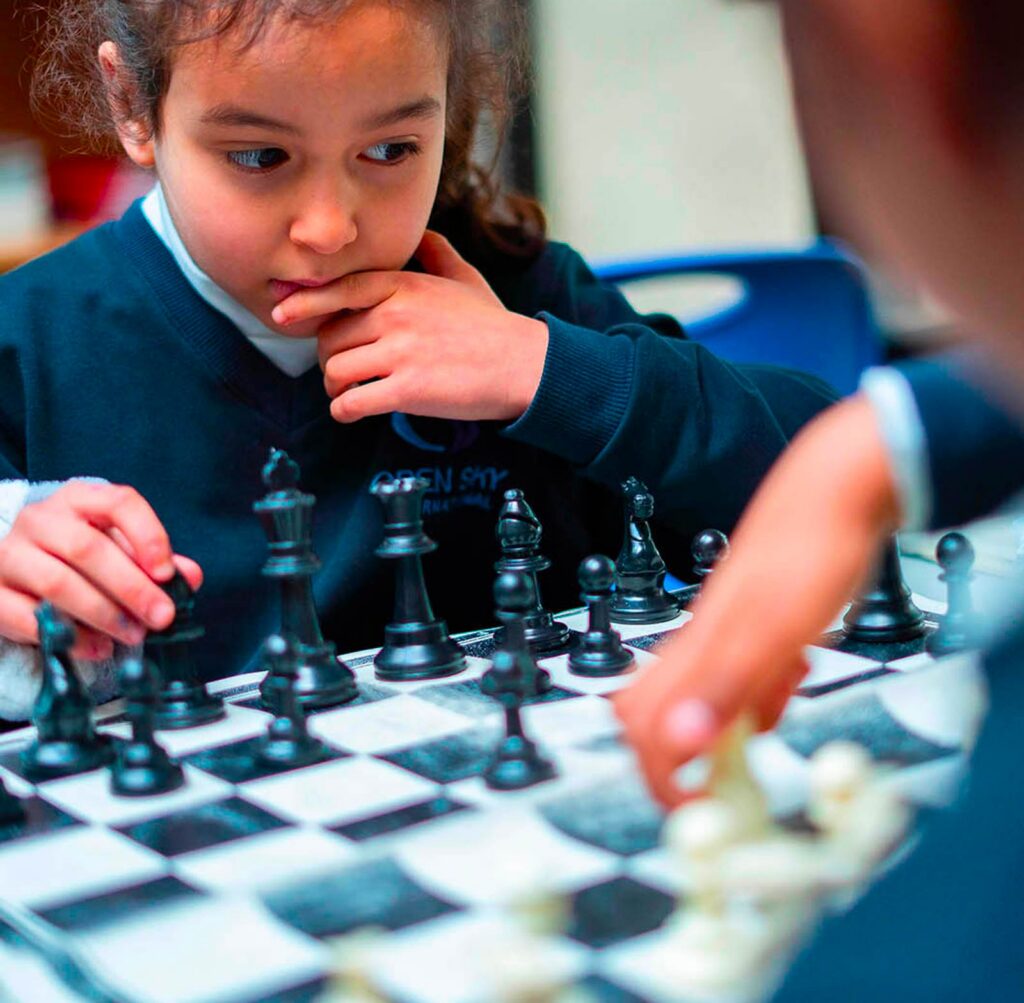
Our approach to excellence does not rely on selection at entry; the high standards apply to the work asked of each student. We expect our students to have a good command of every subject, a willingness to work hard, curiosity and respect for others. This approach leads to GCSEs and IGCSEs in Year 11 (2de), then to A Levels, sat at our accredited Pearson Edexcel examination centre since 2022.
High standards also mean homework from Year 1 (GS), adapted to the child's age, regular assessments in both languages, and a school report that describes what the child can do as well as giving a mark.
In primary, doors open at 8:10 am. Monday is the English day. The children start the week with sport: a bus takes the group to the stadium, where a range of sports are played. When they return, maths is taught exclusively in English. Then comes lunch and a trip to the park. The afternoon continues in English with science and English. Here, English is not taught as a foreign language but as a subject in its own right, as it would be for a child in England.
The next day, it is time for French. A second teacher takes over to teach French, history and geography, as well as drama and chess. Lessons end at 4:30 pm. Children can stay for homework support or after-school care (until 6:30 pm).
On Wednesdays, there are lessons in the morning only, until 11:30 am. One Wednesday in two is in English, the other in French. It is also assessment day.
This rhythm stays the same all year, because in our teaching approach regularity matters more than intensity in making a child bilingual.
A visit during lessons: come and visit our bilingual school and choose either the French day or the English day.
Yes, this is the foundation of our bilingual teaching approach: each language is taught by a native-speaker teacher and used to learn something other than the language itself. In French, our students meet the standards of the French curriculum, and in English they sit the same exams as British students. In fact, all of them sit GCSE French, and in 2026 100% of students achieved Grades 9–7, with 60% achieving a Grade 9.
In a bilingual section, English is a reinforced subject; in an English-speaking school, French is. In our teaching approach, both are languages of instruction, every day. Neither language is favoured over the other.
Yes. On enrolment, a language assessment evaluates your child's skills in French and English. Where needed, they then follow a tailor-made EAL or FAL programme, built into their week, until they can follow every subject in both languages.
We guarantee a maximum of 20 students per class, which allows individualised teaching in both languages.
Each child is monitored individually. The teaching team meets regularly to identify any difficulties and to highlight the progress made. When a child is having difficulty, we look to understand why and work to find solutions.
There is homework from Year 1 (GS). It is, of course, adapted to the child's age. Homework is set in advance, never from one day to the next. It helps to build good work habits from primary school onwards.
Contact us, and we'll get back to you within 24 to 48 hours.
Quelques places disponibles pour 2026 !
Préparez votre rentrée 2027 !
Some available places for 2026 !
Prepare your 2027 school year !