


At Open Sky International, we have chosen to adopt a teaching approach inspired by the Singaporean model in mathematics from the earliest years of schooling. This choice is in line with our vision of an international and bilingual school in Paris founded on academic rigour, a deep understanding and the development of lasting skills.
For several years now, the Singaporean model has been attracting growing interest in international and bilingual schools worldwide. Its excellent results in international assessments, as well as its pedagogical coherence, have made it a benchmark studied far beyond Asia.
But what exactly does this ‘Singaporean model’ consist of? How does it differ from mathematics teaching in France? And why does it now exert such a significant influence on international schools?
Singapore: academic results among the best in the world
For over twenty years, Singapore has been among the highest-performing education systems in mathematics.
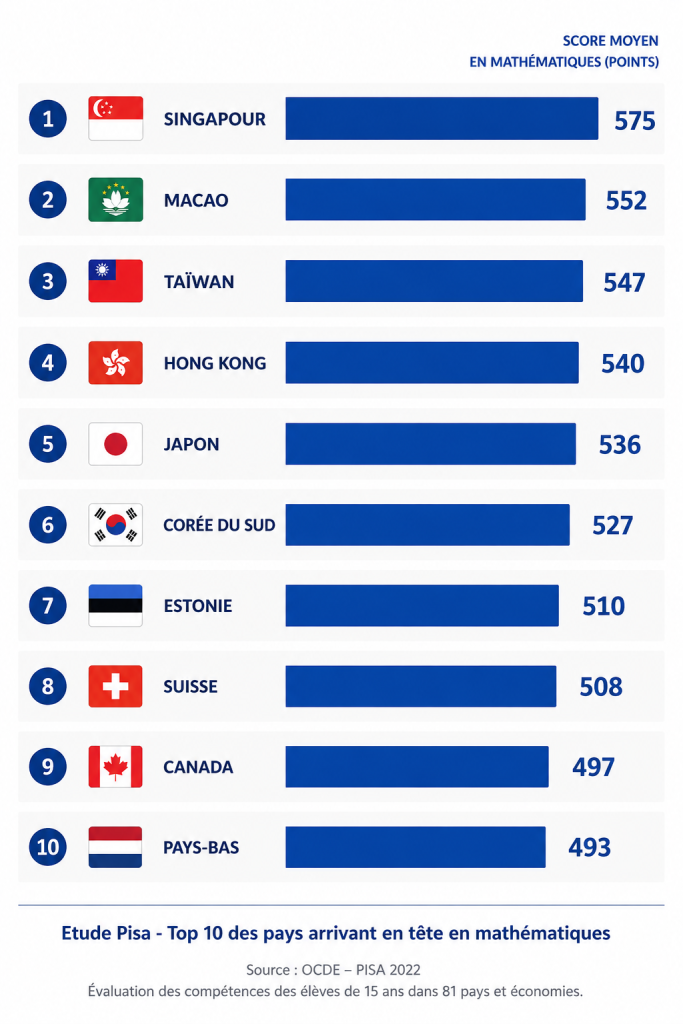
In the OECD’s PISA 2022 study, which assesses the skills of 15-year-old students across 81 countries and economies, Singapore achieved an average score of 575 points in mathematics, compared to the OECD average of 472. The country thus ranks first in the world.
Source : OCDE, PISA 2022.
The gap is particularly pronounced at advanced levels: according to the OECD, 41% of Singaporean students reach levels 5 or 6 in mathematics, compared with an average of 9% across all OECD countries.
France, meanwhile, scored 474 points, close to the OECD average, but with significant disparities based on social and educational background.
These results partly explain why many international, private and bilingual schools in Paris are now taking an interest in the Singaporean educational model.
The ‘Singaporean model’: what exactly is it?
The term ‘Singaporean method’ is often used in the field of education, but it warrants clarification.
International schools rarely use the full Singaporean national curriculum. Instead, they draw inspiration from:
-
- the pedagogical philosophy of the Singaporean system;
-
- the ‘Singapore Maths framework’;
-
- derivative teaching tools such as Primary Mathematics or Dimensions Math..
This model is based on several key principles:
-
- conceptual understanding before memorisation;
-
- a structured progression;
-
- problem-solving;
-
- in-depth mastery of the fundamentals (‘mastery learning’).
This coherence of the curriculum is often cited as one of the main strengths of the Singaporean education system.
An approach centred on conceptual understanding
The French system is historically recognised for the quality of its logical structure and its high level of abstraction, particularly in advanced classes. France also maintains a tradition of internationally recognised mathematical excellence in higher education and research.
The Singaporean model, for its part, adopts a more explicit and visual progression in the early years of learning, placing particular emphasis on conceptual understanding.
One of the best-known features of this approach is the model:
Concrete → Pictorial → Abstract (CPA)
This progression involves:
- the manipulation of concrete objects;
- the use of visual representations;
- the gradual introduction of abstract concepts.
It is important to note that this approach is not a Singaporean invention. It draws inspiration in particular from the work of the psychologist and researcher Jerome Bruner, as well as from various research in cognitive science and constructivist pedagogy.
The Singaporean system has, however, made a significant contribution to the structuring and widespread adoption of this approach in a coherent and large-scale manner.
This influence now extends far beyond Singapore. Many international schools and several English-speaking education systems, notably in the United Kingdom, have gradually incorporated certain principles derived from Jerome Bruner’s work and the CPA approach into the teaching of mathematics in primary schools.
Research in cognitive science also shows that visual representations and hands-on manipulation facilitate the construction of mathematical mental models, particularly during the early years of learning.
‘Learning by mastery’: progressing more slowly, but more firmly
One of the fundamental principles of the Singapore model is ‘learning by mastery’.
The idea is simple: pupils must have a thorough grasp of one concept before moving on to the next.
Unlike some systems where curricula progress rapidly at the risk of creating cumulative gaps, the Singapore model prioritises:
-
- depth rather than quantity;
-
- consolidation of learning;
-
- lasting understanding.
This approach aims to reduce long-term difficulties in mathematics and build particularly solid foundations.
A strong culture of problem-solving
The Singaporean model also places a central emphasis on problem-solving.
Mathematics is not simply viewed as a set of procedures to be applied, but as a tool for reasoning and analysis.
The aim is to develop:
-
- logical thinking;
-
- analytical skills;
-
- strategic thinking;
-
- intellectual independence.
This approach is now particularly sought after in international and bilingual schools, as it prepares pupils for international academic and professional environments that are more focused on analysis and the resolution of complex situations.
Why Singapore’s results cannot be explained solely by its teaching methods
It would be simplistic to attribute Singapore’s performance solely to its method of teaching mathematics.
Researchers and international institutions highlight several complementary factors:
-
- the quality of teacher training;
-
- the coherence of the national curriculum;
-
- the importance placed on mathematics within the education system;
-
- regular monitoring of pupils;
-
- a strong school culture;
-
- high standards.
It is precisely the overall coherence of the system that largely explains its international results.
Why is this approach particularly well-suited to international schools
In an international school in Paris, pupils often find themselves in a multilingual and multicultural environment.
Some arrive without speaking French, whilst others regularly change school systems as they move from one country to another.
In this context, the approach inspired by the Singaporean model offers several advantages:
-
- a highly visual teaching method;
-
- explicit progression;
-
- a strong emphasis on understanding;
-
- concepts introduced progressively.
This approach makes learning mathematics easier for international pupils, particularly when they are learning several languages simultaneously.
In a bilingual school such as Open Sky International, this teaching method fits naturally into a demanding international school environment.
Why Open Sky International draws inspiration from the Singaporean model
At Open Sky Internationalour aim is not simply to produce pupils who excel in mathematics, but pupils capable of understanding, reasoning, analysing and solving problems with confidence.
The approach inspired by the Singaporean model is fully in line with our vision of international education:
-
- developing understanding before memorisation;
-
- building a solid academic foundation;
-
- encouraging intellectual independence;
-
- supporting students of different nationalities in a bilingual and multicultural environment.
This approach is currently helping to shape the development of many international and bilingual schools around the world.